

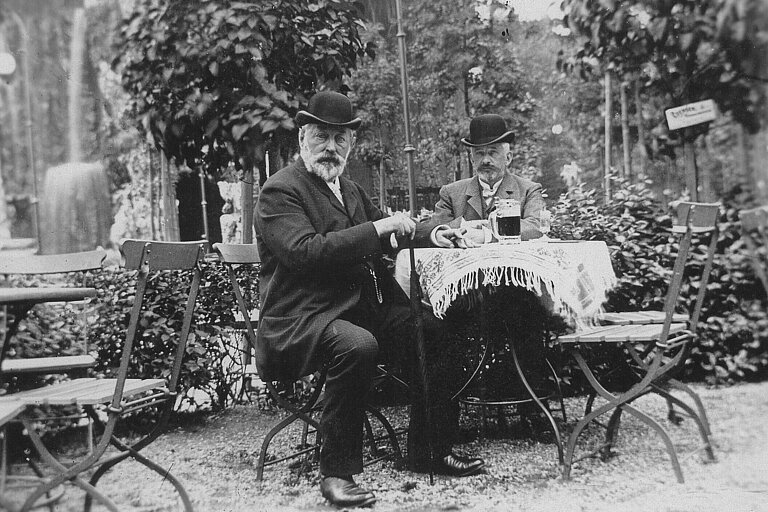
The debate about the colonial history of Leipzig, the human zoos at the zoo and Zoo Leipzig Director Ernst Pinkert
A source-critical approach
Zoo Leipzig has close contacts from all over the world as an international organisation and expressly distances itself from all forms of racism and post-colonialism. Repeated accusations that the zoo is trying to hide or play down its own ‘colonial past’ are contradicted by publications and the recent commission of historian Dr. Mustafa Haikal to review and assess the sources of information. The results of this comprehensive study are published here.
For centuries, colonialism affected many areas of life. The early European zoos can also be linked to colonialism and were not least about the symbolic and real appropriation of the colonial world. An important example of this are the so-called human zoos, which have been the subject of scrutiny over recent years. Despite the empathy that is necessary for those who suffered, it is important not to demonise the exhibits, but to analyse them clearly and objectively. With regard to Zoo Leipzig, where around 40 human zoos took place, this is extremely difficult. The zoo's historical archive contains virtually no documents from the time of Ernst Pinkert, the zoo's founder and first director, and very few from the years when it was a public limited company. There are no contracts, letters, reports or other documents relating to the human zoos at the zoo, except for a collection of newspaper clippings dating back to 1893. Numerous attempts to expand the sources of information on the early history of the zoo through research in other archives have been unsuccessful, except for a few minor findings.
A second problem arises from the fact that, with a few exceptions, the human zoos made stops at Zoo Leipzig, but their impresarios came from other cities, where they planned and put together the exhibits. The sources from Leipzig therefore provide only very limited information on the subject. Despite all efforts, no documents could be found that would provide information about the feelings and experiences of the participants in the human zoos in Leipzig or about critical voices from the public in Leipzig. Sources of this kind are generally rare for the period of the German Empire. In the end, the main hope remains that new documents will become known because of the extensive digitisation projects of German archives and libraries.
By evaluating the zoo's collection of newspaper clippings mentioned above and by researching various journals and daily newspapers, around 90 press articles on the human zoos at Zoo Leipzig when Ernst Pinkert was director, were found. These reflect the arrival of the participants, the programme, accommodation, food, expectations and reactions of the audience, and provide information about the domestic and wild animals brought along, clothing and other details. Nevertheless, caution is advised when going through them. Newspaper reports are highly interesting but unreliable sources that usually need to be verified with the help of other documents. The political attitudes and personal influences of journalists can be reflected in newspaper articles, as can the wishes of the impresarios and organisers.
Nevertheless, some conclusions can be drawn about the human zoos examined (two of which took place before the zoo was founded), although the programme of the shows will not be discussed again here. Instead, we would like to point out that authors such as the painter Heinrich Leutemann and the writer Rudolf Cronau reported on the events in a sober and, in some cases, even idealising manner, showing curiosity, understanding and sympathy towards the participants. Heinrich Leutemann from Leipzig, for example, emphasised the anthropological and zoological character of the Lapland show in 1875, as the five participants appeared with their reindeer. His style is factual and free of any resentment. In contrast, the Dakotas who visited Leipzig in 1886 are described in a more idealised manner. There is talk of ‘well-educated men’ with ‘energetic and bold faces’ who performed circus-worthy feats. However, there are differences from show to show. The more foreign and different the people on display were, the greater the distance grew, and especially in the case of groups from sub-Saharan African and Latin American countries, numerous racist stereotypes can be identified, with reports dominated by the certainty of ‘cultural superiority’ (for example, in the case of the Ashanti human zoo in 1899). The extent to which these stereotypes increased over the years would need to be examined more closely. The growing imperial and colonial ambitions of the German Empire also influenced the human zoos, some of which were advertised and viewed differently after the colonies were taken over (‘Germans of the South Seas,’ ‘Samoa – Our New Compatriots’). All the shows served to entertain the audience, and Carl Hagenbeck's early attempts to convey as authentic an image as possible of some of the groups (a construct that was of great importance to the zoo ) soon paled in significance.
With the understanding of later generations, the mere fact that people were put on display in front of other people in the zoo must be described as a form of discrimination, especially when one considers the ideas and impressions with which visitors came to the events. However, there is no evidence in newspaper reports of cases of rough treatment or lack of food during the Pinkert era. The idea that the participants in the ethnological human exhibits were displayed like animals behind bars is a myth in Leipzig, and where there were barriers, they often served to protect those affected by the curiosity and intrusiveness of the visitors.
As far as one can tell from the sources, the participants in the Leipzig human zoo came to Europe voluntarily and with contracts, although they generally had no idea of the hardships and dangers they would be exposed to. The continuous stream of curious visitors, the unfamiliar treatment they received and anthropological measurements (documented in Leipzig only for the ‘Dinka Negro Exhibition’ of 1895) caused them just as many problems as the climate. Some of the participants in the ethnological exhibition lived in accommodation they had brought with them or quickly cobbled together (tents, yurts and huts) and are likely to have frozen during the cold seasons. The event hall of Zoo Leipzig, built in 1876, known as the Skating Rink, which housed some of the exhibits, was a wooden structure open on several sides, and only the Völkerbühne (People's Stage) that was added later had brick rooms. Research by many authors shows that the unfamiliar diet caused problems for the participants and that there were numerous cases of diarrhoea and colds.
According to the available information, two deaths are documented during the ca. 50 years that the human zoos were held at Zoo Leipzig (an Ashanti child in 1899 and a 32-year-old man from Ethiopia who died of pneumonia in 1906). In addition, there must have been other isolated deaths in the groups that visited Leipzig at other tour locations. Zoo Leipzig was apparently spared impresarios such as Robert Cunningham, who brutally and ruthlessly exploited his ‘performers’. Even the disastrous human zoos with ‘eight inuits and eleven inhabitants from Tierra del Fuego, which ended in 1880–1882 with the death of most of the participants due to illness, did not stop here.
The accusations against zoo founder Ernst Pinkert, which relate almost exclusively to the human zoos, therefore need to be differentiated. Pinkert was a man of the 19th century who had his own time horizon, just as we have ours today. Much of what he did, we would do differently today or consider it unacceptable by today's standards.
From today's perspective, the fact that Pinkert organised these shows or provided space for them is one of the contradictions in his biography. Pinkert was part of a social and political system in which hardly anyone took offence at the human zoos, neither the Leipzig city administration, nor the directors of the zoos, the scientists at the university or the citizens and workers.
As far as the reappraisal of the human zoos and Pinkert's biography is concerned, it was Zoo Leipzig that first presented the topic to the public in its 2003 anniversary volume, co-authored by Dr Haikal, on the basis of the available sources of information after decades of complete silence. In order to give readers the opportunity to form their own opinions, the relevant pages were extensively illustrated and accompanied by eleven historical newspaper reports, with a focus on critical points. To this day, almost all discussions on the subject draw on this publication, which underlines its lasting impact and the zoo's reappraisal of the subject. Although human zoos were not the focus of attention in the context of historical reappraisal at the time, they were by no means covered up or trivialized.